


Contact

Dan L. Bagatell

PHONE: 602.351.8250
Download V-Card >

Kathleen (Katie) M. O'Sullivan

PHONE: 206.359.6375
Download V-Card >

Appellate

  | 

Overview

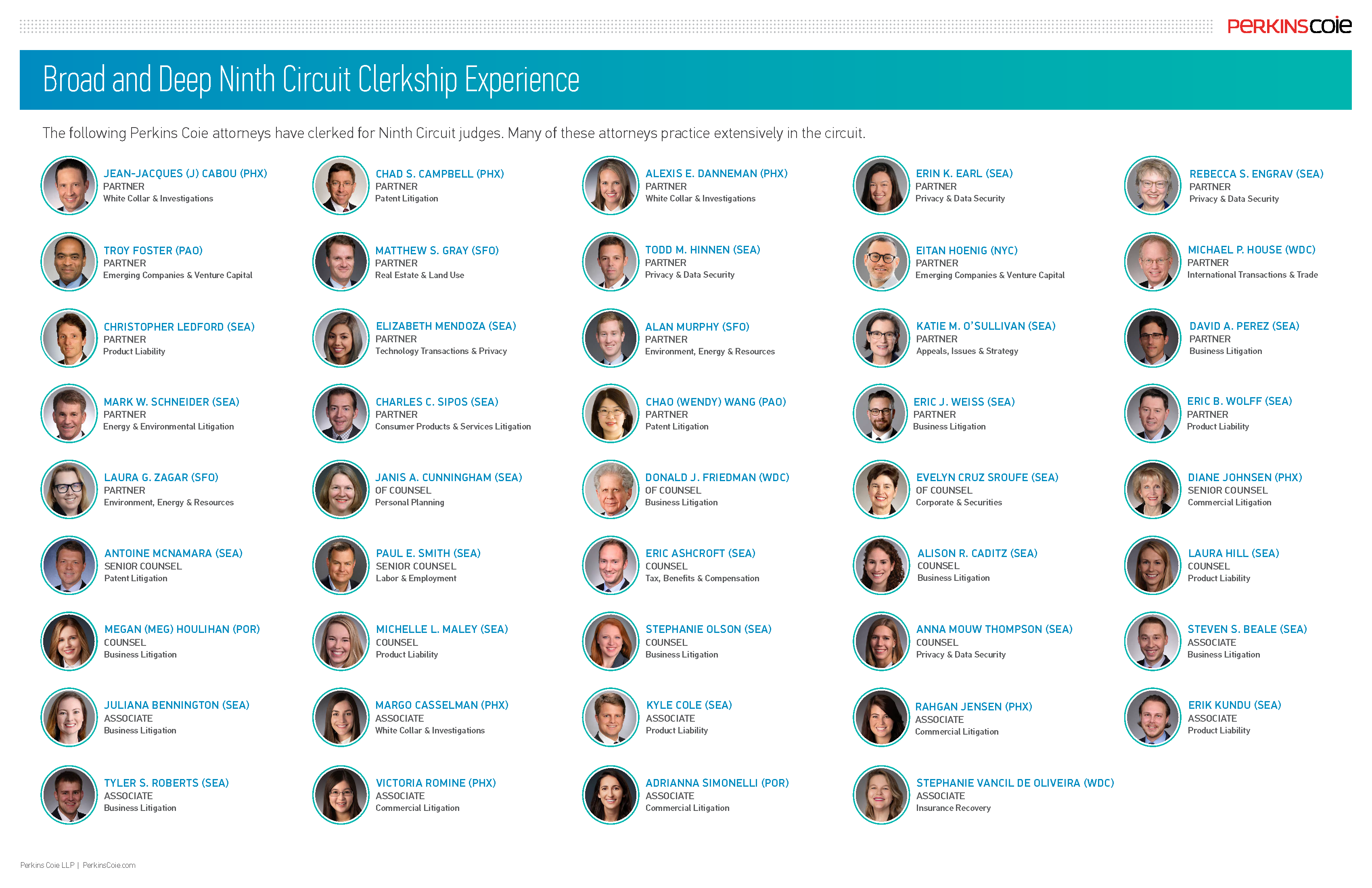
Perkins Coie's Appellate Practice group defends victories and seeks relief for clients in appellate courts across the country. We have represented clients before the U.S. Supreme Court, every federal appellate circuit court, many state appellate courts and dozens of federal and state agencies. Our experience before federal and state courts in Washington, Oregon, California, Arizona, Idaho and Alaska is especially deep. In addition, dozens of our appellate attorneys have served as federal or state appellate judicial clerks. That collective “insider" experience gives us insight into the reasoning and arguments that will resonate with appellate courts.

The matters we handle span the spectrum of civil, business and regulatory issues, and often involve complex records and emerging or unsettled law. Although we focus on appeals, our work often begins before the appeal stage. We regularly consult with clients and trial counsel to help shape trial strategies and preserve important issues for appeal. We also assist with key pre- and post-trial motions that set the stage for appeal. We excel at teaming with trial lawyers — both at our firm and other firms — so that our clients benefit from both the in-depth knowledge of their trial lawyers and the fresh perspective and expertise of appellate counsel.

We also have an active amicus practice that enables our clients (and often entire industries) to weigh in on important issues in appeals involving other parties. In addition, we assist our clients with special projects such as position papers, comments on proposed statutes and regulations, and analyses of recent changes in law.

Examples of recent matters we have handled include:

  • First Amendment Law. We successfully represented yellow pages publishers in a challenge to a Seattle ordinance that required them to obtain permits from the City, pay a fee for each book they distributed, participate in a City-run delivery opt-out program, and advertise that program on the cover of each directory. In a unanimous published opinion, the Ninth Circuit concluded that “yellow pages directories qualify for full protection under the First Amendment” and therefore reversed the district court and struck down the Seattle ordinance. Dex Media West, Inc. v. City of Seattle, 696 F.3d 952 (9th Cir. 2012). 

  • Military Justice. Following our success in the landmark decision of Hamdan v. Rumsfeld, 548 U.S. 557 (2006), we successfully represented Mr. Hamdan in appealing his military commission conviction of "material support for terrorism." On appeal, the D.C. Circuit reversed the conviction because, at the time of his conduct, the statute under which he was prosecuted did not treat material support for terrorism as a war crime. The court refused to read the law as retroactively punishing new crimes. Hamdan v. United States, 696 F.3d 1238 (D.C. Cir. 2012).

  • Political Law. We successfully represented Al Franken in litigation over the 2008 general election for United States Senator from Minnesota. By a unanimous vote, the Minnesota Supreme Court rejected federal constitutional and Minnesota state law objections by Mr. Franken’s opponent, Norm Coleman, and held that Mr. Franken was entitled to a certificate of election. In re Contest of Gen. Election Held on Nov. 4, 2008, 767 N.W.2d 453 (Minn. 2009).

  • Constitutional Law. In a case in which we represented intervenor Washington Families Standing Together, the United Supreme Court ruled in favor of our client and the State of Washington, rejecting a claim that disclosing the names of people who had signed referendum petitions would violate the First Amendment. Doe v. Reed, 130 S. Ct. 2811 (2010). The case arose out of a state law extending certain benefits to same-sex couples. Some of the challengers who sought to put that law to a popular vote did not want their names revealed. By an 8-1 vote, the Supreme Court rejected the petitioners' facial claim of a First Amendment violation. 

  • Electronic Advertising Law. In Kleffman v. Vonage Holdings Corp., 232 P.3d 625 (Cal. 2010), the California Supreme Court unanimously agreed with our client, Vonage, that California's "anti-spam" law did not prohibit sending commercial email advertisements from multiple domain names for the purpose of bypassing spam filters. Hearing the case on a certified question from the Ninth Circuit, the Court held that using multiple domain names does not constitute misrepresenting email header information and noted that the plaintiff's construction would have resulted in preemption by the federal CAN-SPAM Act.

  • Product Liability. In Getz v. The Boeing Co., 654 F.3d 852 (9th Cir. 2011), cert. denied, 132 S. Ct. 1582 (2012), the Ninth Circuit agreed with us that Boeing (the manufacturer of an Army helicopter that crashed in Afghanistan) and two component suppliers were entitled to summary judgment based on the government contractor defense. In Turbomeca, S.A. v. Era Helicopters LLC, 536 F.3d 351 (5th Cir. 2008), we persuaded the Fifth Circuit that the economic loss rule of East River Steamship Corp v. Transamerica Delaval, Inc., 476 U.S. 858 (1986), allows no exception for alleged post-sale negligence. The court accordingly affirmed the dismissal of claims that our client, a manufacturer of helicopter engines, negligently failed to warn about an alleged pre-sale product defect.

  • Intellectual Property. In MySpace, Inc. v. GraphOn Corp., 672 F.3d 1250 (Fed. Cir. 2012), the Federal Circuit affirmed a district court’s grant of summary judgment that four patents asserted against our client craigslist and other defendants were invalid over prior art. In Monolithic Power Systems, Inc. v. O2 Micro International Ltd., 558 F.3d 1341 (Fed. Cir. 2009), the Federal Circuit affirmed that patent claims that had been asserted against our client were invalid as obvious. Along the way, the court of appeals upheld the district court’s authority to appoint independent experts in patent cases under Federal Rule of Evidence 706. 

  • Consumer Protection.  In Turek v. General Mills, Inc., 662 F.3d 423 (7th Cir. 2011), the Seventh Circuit affirmed the dismissal of a class action against our client, General Mills, on grounds that the plaintiffs’ deceptive advertising claims were preempted by the Nutrition Labeling and Education Act, which sets forth uniform standards for food labeling.

  • Securities and Corporate Governance. In Sound Infiniti, Inc. v. Snyder, 237 P.3d 241 (Wash. 2010), the Washington Supreme Court adopted our arguments that divested shareholders do not have standing to bring shareholder derivative claims under Washington law and that appraisal proceedings under Washington's Business Corporations Act are the exclusive remedy for minority shareholders dissenting from fundamental corporate changes unless the corporate action was fraudulent or procedurally defective.

  • Natural Resources. In Klamath Irrigation District v. United States, 227 P.3d 1145 (Or. 2010), the Oregon Supreme Court ruled for our clients (water users in the Klamath River Basin) and held that they could pursue federal court claims that the U.S. government took their property without just compensation when it terminated delivery of water from a federal reclamation project. The Oregon Supreme Court heard the case on certified questions from a federal circuit court.

  • Environmental Law. In Coeur Alaska, Inc. v. Southeast Alaska Conservation Council, 557 U.S. 261 (2009), we were co-counsel for the petitioner and convinced the Supreme Court to rule that the Army Corps of Engineers, not the Environmental Protection Agency, had the authority to permit discharges under Section 404 of the Clean Water Act. 

  • Telecommunications. In Qwest Corp. v. Arizona Corporation Commission, 567 F.3d 1109 (9th Cir. 2009), the Ninth Circuit adopted our position that state utility commissions have no power to enforce obligations under Section 271 of the Telecommunications Act of 1996 and that conflict preemption prohibits state utility commissions from imposing unbundling requirements that the Federal Communications Commission has withdrawn. 

  • Tax. Homestreet, Inc. v. State of Washington, Department of Revenue, 210 P.3d 297 (Wash. 2009), the Washington Supreme Court reversed the Washington Court of Appeals and held that the servicing fees earned following the sale of residential mortgage loans on a servicing-retained basis constitute "amounts derived from interest" and therefore are deductible for B&O tax purposes. This decision is important to all financial institutions that sell their loans on the secondary market in the State of Washington.